
A Company Running on an NVIDIA DGX 💚

Updated: Apr 26
When we walked into NVIDIA's HQ and sat down with their robotics team, something clicked that changed how we think about deployment entirely.

We weren't there to talk about the cloud. We weren't there to talk about remote inference or centralized model servers. The conversation kept coming back to one thing: the intelligence has to live where the robot lives.

On the factory floor. In the training center. Inside the facility. The deployment model for humanoid robotics isn't cloud-first it's on-premise first, running on servers that travel with the robot and operate independently of any external connection.
That conversation crystallized everything we had been building toward.
The bottleneck in humanoid robotics is not the hardware. It's the intelligence layer on top of it and where that intelligence runs.
That's why we built Robots ID an end-to-end operating system to train and deploy humanoid robots in industrial environments. And that's why the infrastructure question is now at the center of everything we do.
Where We Are Today
In February 2026, we launched Robots ID and rebranded as Humandroid. In March, we presented at NVIDIA GTC 2026 and MWC Barcelona.
The reception confirmed what we already felt: the ecosystem is aligning faster than anyone anticipated.
NVIDIA isn't betting on a single product. They're building the complete infrastructure Isaac Sim, GR00T N1.6, Cosmos, Omniverse for robots to learn, simulate, and deploy at scale. We're building the operating system on top of that same stack.
We came back from San Jose with one clear conviction: the window to define the software layer of humanoid robotics is right now.
And with that conviction came a very specific question:
How do we deliver Robots ID at enterprise scale reliably, securely, and fast?
The answer led us directly to NVIDIA AI Enterprise.
A Company Running on a DGX
Machines like the NVIDIA DGX Spark — 1 petaFLOP of AI performance, 128 GB of unified memory, Grace Blackwell architecture are redefining what on-premise compute means for a startup.

We're not talking about a workstation. We're talking about a personal AI supercomputer on your desk.
At Humandroid, we're building toward a model where our entire operation runs on this kind of infrastructure:
The training of humanoid robots our VLA pipelines, synthetic data generation in Isaac Sim, Imitation Learning flows running locally, with full data sovereignty, at the facility where the robot operates.
And the AI agents that develop and operate Robots ID itself the agents that accelerate our development cycles, monitor training experiments, and automate our infrastructure also running on the same hardware. On-premise. Private. Always on.
One machine. One closed loop. Zero dependency on the cloud for what matters most.
The Path to NVIDIA AI Enterprise
This isn't just an infrastructure decision. It's a positioning decision.

NVIDIA AI Enterprise is the full production-grade software suite that brings together microservices, frameworks, and libraries for AI development with advanced GPU orchestration, enterprise support, and a secure software supply chain. It's the trusted, certified path from AI prototype to industrial production.
Three things make it the right foundation for Robots ID:
Trusted Production Deployment. NVIDIA AI Enterprise provides extended-life production branches, vulnerability mitigation, and hardened containers with security deployment guides. For industrial clients in automotive, energy, and oil & gas, this is critical. They're not running experiments. They're running operations.
Faster Time to Value. Through NVIDIA NIM microservices ready-to-deploy AI components and advanced GPU orchestration that increases data scientist GPU availability up to tenfold, teams move from prototype to production without rebuilding from scratch. Robots ID deploys on top of this foundation, ready to run from day one.
AI Workloads at Scale. NVIDIA Run:ai provides dynamic compute orchestration across the full AI lifecycle maximizing GPU utilization, scaling workloads, and integrating into hybrid infrastructure. For a fleet of humanoid robots training in parallel across multiple industrial facilities, this is the orchestration layer that makes it work.
And critically: NVIDIA Omniverse the platform for industrial digital twins and robotics simulation is native to the enterprise stack. Our synthetic data generation pipeline and multi-robot fleet simulation run directly within the same ecosystem.
What This Means for Robots ID
By aligning Robots ID with NVIDIA AI Enterprise, we're not just using NVIDIA as a tool.
We're becoming a native application of the NVIDIA Enterprise ecosystem.
That means industrial clients who already operate within the NVIDIA stack don't need to build a new robotics AI environment from scratch. They get Robots ID running on the hardware they already trust from a DGX Spark at the edge, scaling to DGX Station and beyond for larger fleets.
The training center. The synthetic data pipeline. The VLA training infrastructure. The fleet management layer. All of it, delivered as a service, certified on NVIDIA infrastructure, with the full weight of NVIDIA's enterprise support behind it.

The biggest friction in humanoid robotics adoption isn't the robot — it's the question of where does the intelligence live, who controls it, and how does it integrate with what we already have.
Robots ID on NVIDIA Enterprise answers all three:

The intelligence lives on hardware the client already knows. They control their data entirely — on-premise, encrypted, compliant. And it integrates natively with the same NVIDIA stack they use for simulation, digital twins, and AI development across the rest of their operations.
And this includes the hardware itself. Our clients will be able to deploy Robots ID directly on-premise on devices like the DGX Spark — on the factory floor, in the training center, in the same facility where the robots operate. No cloud dependency. No network latency for what's critical. Full sovereignty over training data and learned policies. A single DGX Spark on-site is everything needed to run the complete cycle teleoperation, data capture, training, and policy deployment operating autonomously and securely within the client's own four walls.
The Bigger Picture
There's a version of this story that ends with humanoid robots being trained, deployed, and managed entirely within NVIDIA's infrastructure ecosystem with Robots ID as the operating system layer that makes it work.
That's not a distant vision. It's the direction we're actively building toward, one certified deployment at a time.
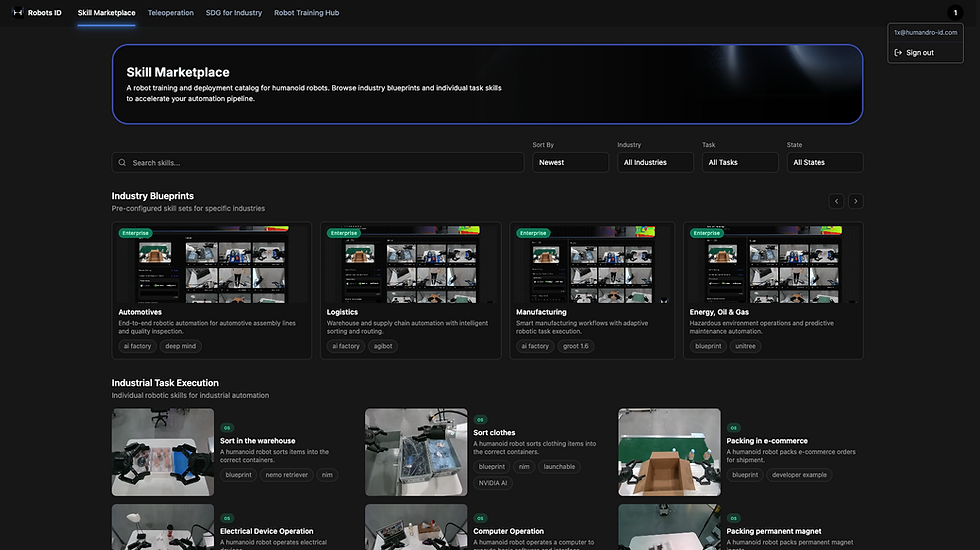
This is what it looks like when a company fits inside a DGX. 💚


Comments