
TGN & Humandroid


The first humanoid robot in Latin America purpose-built for teleoperation and autonomous valve aperture operations in critical gas infrastructure.
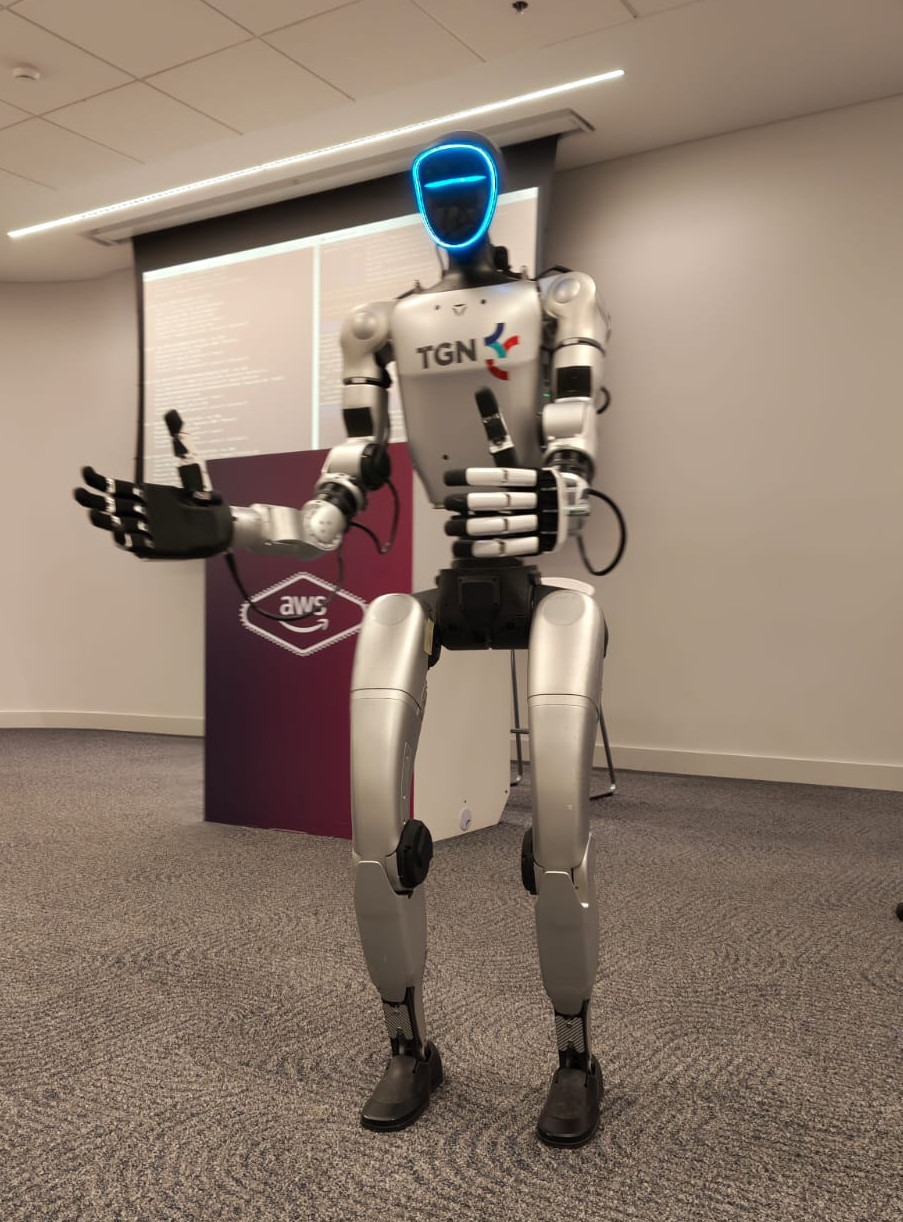
June 29, 2026. AWS Argentina's offices. A moment that felt like a turning point.
We stood in front of a room full of industry leaders, partners, and skeptics all gathered to witness something most people thought was still years away: a Unitree G1 humanoid robot, remotely operated by a human

This is the story of how TGN (Transportista de Gas del Norte), Humandroid, Binbash, and AWS built something that changes the equation for industrial robotics in Latin America and what it means for the future.
The Problem Nobody Wanted to Say Out Loud
Gas pipeline operations are dangerous. Valve aperture operations especially. A human technician standing in front of a pressurized gas valve isn't just doing a job they're taking a calculated risk every single time. Exposure to confined spaces, high pressure systems, extreme temperatures, and unpredictable conditions are the norm, not the exception.
For decades, TGN had one choice: send people into those conditions, implement expensive automation that required massive capital investment and years of engineering, or accept the operational bottleneck and risk.

Then someone asked a different question: What if a humanoid robot could do this remotely, safely, and with the precision a mission-critical operation demands?
That question led to a conversation. And that conversation led to the POC that changed everything.
Why This Matters: The Tripartite Model (Plus the Best Part: The People)
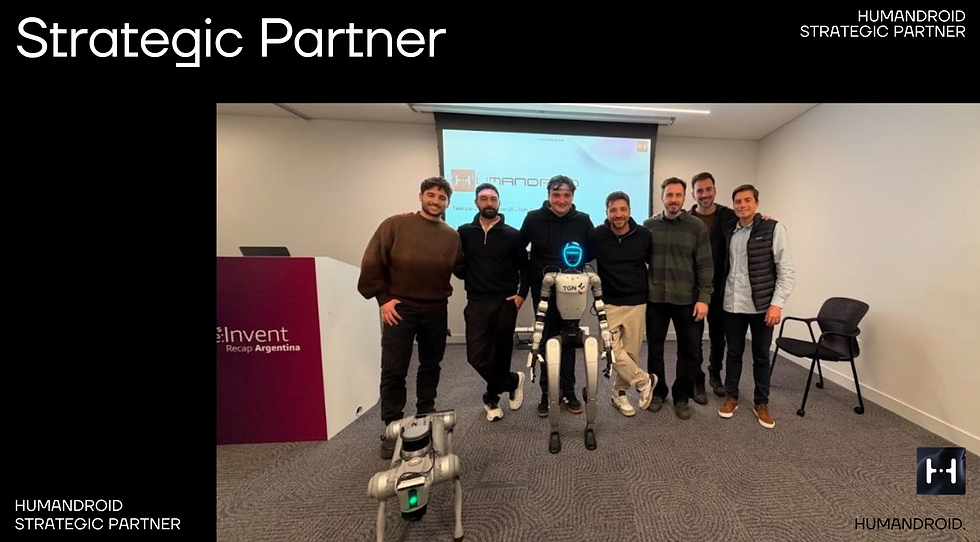
When Humandroid started working with TGN in 2025, we didn't just show up with a robot and training data. We showed up with a partner Binbash who understood infrastructure at a level that mattered. And behind both of us was AWS, providing the cloud backbone that made the whole thing possible.
But here's the part that really matters: the teams that made it work.
On the TGN side: Eduardo Daniel Mascaro led the effort and he's not a CTO hiding in a lab. He's an infrastructure engineer who understands the operational reality of gas pipelines. Franco Berni (a brilliant engineer embedded with the TGN team), Roberto AXT, and Fabricio Vedoba weren't just stakeholders they were collaborators. They spent months with the Unitree G1, understanding its capabilities, pushing its limits, and capturing the data that would eventually train the autonomous system. This wasn't a vendor relationship. It was a partnership.

On the Humandroid side, our team (led by Santiago Braña, our CTO) worked shoulder-to-shoulder with TGN's team. When something didn't work, they didn't just report it they debugged it together. When the data showed the robot needed to adjust its approach, TGN's team provided the operational insight that made the training effective.
Here's why that matters:
Humandroid brought the AI and robotics intelligence. We built the teleoperation interface that allowed human operators to control the Unitree G1 (tagged as HMND-0002 in our fleet) with precision and real-time feedback. We deployed Robots ID our 7-layer operating system for humanoid robotics as the foundation for learning and control. And we're now training the systems that will eventually enable autonomous execution but only after we've captured enough real operational data to do it safely.

Binbash brought the infrastructure layer that most robotics companies ignore until it's too late. Real-time communication protocols, edge computing placement, network reliability, and the kind of operational resilience that doesn't fail when a technician's life depends on it.
AWS provided the cloud compute, the scalability, and the security architecture that meant TGN's data stayed within their perimeter and under their control a non-negotiable requirement for critical infrastructure.
This isn't a story about three vendors selling to a customer. This is a story about three companies that respect each other's expertise, that built without friction, and that proved a model that will be replicated across every critical infrastructure operation in the region.
What We Actually Built
Phase 1 (2025-2026): Teleoperation + Environment Capture + Data Collection
We deployed a Unitree G1 humanoid, trained with our Robots ID operating system, into TGN's operational environment
We built a teleoperation interface that allowed human operators to control the robot's full-body movements with real-time feedback
We captured operational data—the human's movements, the robot's response, the environmental variables, the task execution patterns—all in a live, mission-critical setting
We built a high-fidelity simulator that replicated TGN's physical environment, using real operational data to train the models

What We Showed on June 29:
Live teleoperation: A human operator remotely controlling the Unitree G1's full-body movements through our interface, executing the valve aperture operation in real-time with zero latency loss
Operational data capture: Months of real-world teleoperation data from TGN's environment the foundation for everything that comes next
System architecture: The infrastructure stack (Binbash + AWS) that made real-time control and secure data handling possible at mission-critical scale
Phase 2 (2026-2027): In Progress
We're now training the humanoid to autonomously execute the valve aperture task using the data from Phase 1
We're building the hybrid model: the robot will run autonomously when confident, but a human operator can step in at any moment if judgment or intervention is required
We'll deploy the autonomous system into TGN's live operations and measure performance against teleoperated baselines
The result when Phase 2 completes? A robot that can execute a mission-critical operation with the safety profile of a teleoperated system and the throughput of an automated one.
Why This Is Different From Everything You've Heard Before
Most robotics projects in this space operate in one of two modes:
Full autonomy with optimistic timelines. "We'll have Level 5 autonomy in two years." (Narrator: they won't.)
Teleoperation that requires a human in the loop for every operation. Safer, but it doesn't scale.
TGN proved a third way: progressive autonomy with human oversight. The robot learns from humans, executes autonomously when it's confident, and hands control back to a human when the situation demands judgment.
This isn't just safer. It's more scalable. It's more economically viable. And it's the model that will define industrial robotics for the next decade.
The Data Revolution
Here's something most robotics companies won't admit: they don't have good data. They have lab data. Controlled data. Data that works in a 10x10 meter room with perfect lighting and no surprises.
TGN gave us something different: real data. Environmental variability. Sensor noise. Equipment degradation. The thousand small variables that exist in live operations and nowhere else.
Every hour the robot operated at TGN, we captured operational intelligence. Every mistake it made and it made some was a data point that made the next iteration better. By June 2026, we had trained on months of real-world operational data from a mission-critical infrastructure environment.
That data is now part of Robots ID. It's baked into our foundation models for humanoid control. It's the difference between a robot trained in a lab and a robot trained in the real world.
The Next Chapter
TGN validated the model. But validation isn't the end of the story it's the beginning.
We're now working with TGN on Phase 3: scaling the solution to other valve operations, other segments of their pipeline infrastructure, and eventually, other mission-critical tasks in their operations. Each new task builds on the data and the infrastructure we've already built.
And TGN isn't the only company watching this. When one of the largest gas infrastructure companies in Latin America says "This works," other critical infrastructure operators listen.
We're in conversations with energy companies, logistics operators, and manufacturing facilities across the region. They're asking the same question TGN asked two years ago: What if a humanoid robot could do this safely, reliably, and economically?
We now have an answer backed by production data.
A Special Note: Credit Where It's Due
This project didn't succeed because Humandroid is brilliant. It succeeded because TGN trusted us enough to put their best people on it.
Franco Berni, who embedded with our team and learned the ins and outs of teleoperation and humanoid robotics. Eduardo Daniel Mascaro, who pushed back on our assumptions and made us think harder about operational reality. Roberto AXT, Fabricio Vedoba, and the entire TGN technical team who understood that building something this ambitious requires more than a vendor it requires a partner willing to get uncomfortable.

If you work in critical infrastructure and you're reading this thinking "I wish I had a Franco on my team," you're not alone. The scarce resource isn't the technology. It's the talent willing to sit in a room for six months, learning to work alongside a humanoid robot, capturing data, debugging problems, and believing that something impossible is actually inevitable.

TGN found that talent internally. They invested in it. And now they're about to change how critical infrastructure operates across Latin America.
That's a lesson worth more than the robot itself.
The Broader Vision
Here's what I think about when I think about TGN:

We're not building robots to replace humans. We're building robots to protect humans. To take humans out of situations where the risk is too high, the conditions are too harsh, or the task is too repetitive for a human to sustain.
TGN's valve operations are just the beginning. This model applies to hazmat handling, to confined space operations, to high-temperature environments, to infrastructure inspection, to a thousand industrial tasks where human safety has been the limiting factor.
The vision was always Level 5 autonomy by 2030. But we're not going to get there by chasing autonomous vehicles on highways. We're going to get there by solving real industrial problems, capturing real operational data, and iterating in environments where the stakes are high and the feedback is immediate.
TGN is one step on that path. But it's a really important one.


Comments